Range Repair
Viking Burner Clicks but Will Not Light: An Andover Walkthrough
Clicking only proves the spark module fired — it says nothing about gas reaching the burner. Work out whether one burner or all of them are affected, then check cap seating, blocked ports and the electrode, in that order.
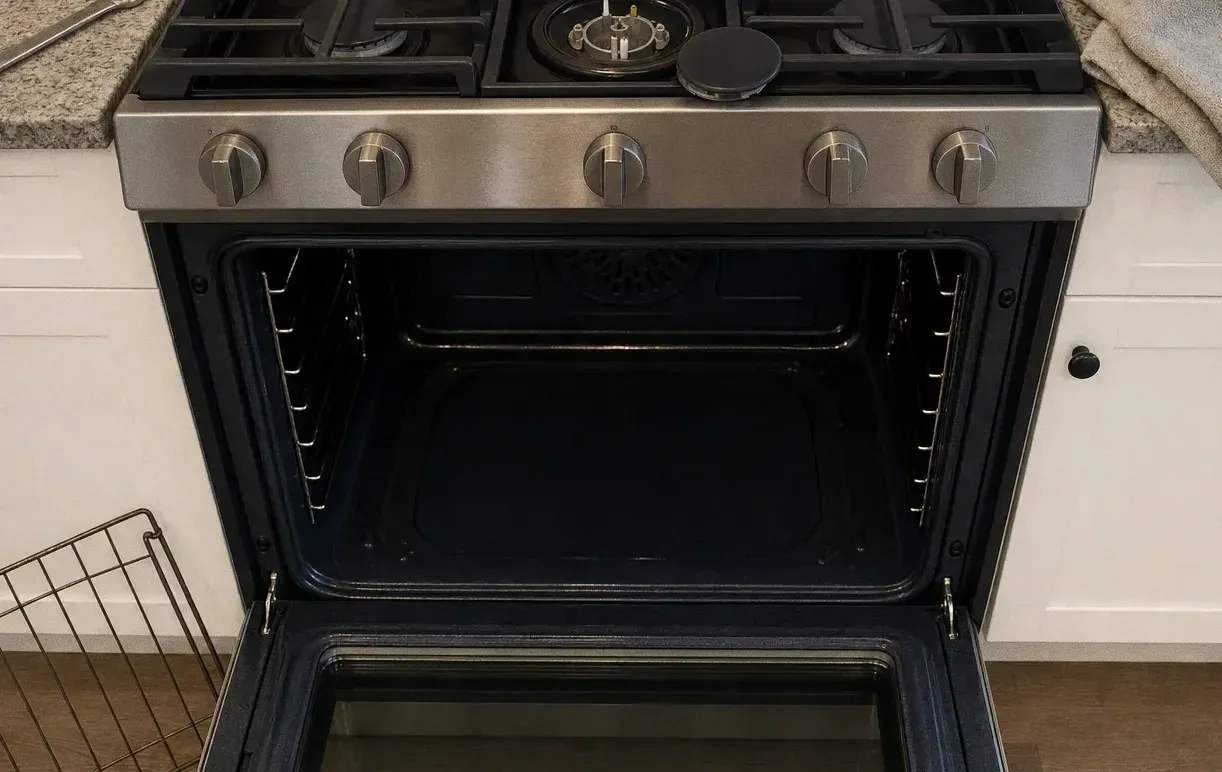
Tick. Tick. Tick. The pan is on, the knob is turned, and the range is doing its impression of a metronome while nothing catches. Sometimes it gives up and you move the pan. Sometimes it lights four or five seconds later with a soft thump that makes everyone in the room look round.
One thing before any of it. A smell of gas that does not clear means everyone goes outside first. Leave the light switches and the extractor alone on the way out, and telephone the gas utility once you are out of the house. That is not a repair call and no appliance firm should be first on your list.
One burner, or all of them? Answer that first
Turn each position in sequence and note which ones click and which ones light. When one burner misbehaves and the rest are fine, the fault is local to that position, which means its cap, its ports or its electrode. Every position clicking and nothing catching points somewhere else entirely: the spark module, the earth, or the gas arriving at the appliance.
A detail that confuses almost everybody: on many ranges all the electrodes share one spark module, so turning one knob sets the whole cooktop clicking. That is normal behaviour, not a fault, and it is not evidence that four burners have failed at once. What matters is which one lights.
Clicking with every knob in the off position is a third, separate condition. It usually means moisture has got into a switch or a switch is holding closed, and it means the appliance should be left alone and the sparking stopped at the breaker rather than lived with.
Write down what you find before you touch anything: which positions click, which light, whether any lights after a delay, and what changed recently. A deep clean, a boil-over, a power cut, work on the gas line. In Ballardvale the renovations tend to be full gut jobs with the range moved to an exterior wall, which means the gas run was re-plumbed — worth remembering if the range has never lit cleanly since the day it went in. In Shawsheen Village, where compact kitchens are built around original chimney breasts and everything sits close together, a boil-over on one side reaches the neighbouring burner before anyone gets a cloth to it.
The cap, the ports and the last time it was cleaned
A cap sitting a fraction proud of its base changes the path the flame has to travel and can stop a burner lighting even when the spark is perfect. Lift the cap off, check the ring beneath it is clean and dry, and set it back so it drops flat rather than perching on a crumb of something.
Test the seating rather than eyeballing it. A correctly placed cap will not rock when you nudge it with a fingertip, and it will sit level with its neighbours. Caps from different positions on the same appliance are not always interchangeable, so if the range was stripped for cleaning and reassembled by hand, that is worth checking too.
Ports are the small openings around the rim. Clear them with something that will not enlarge or deform them: a soft brush, a wooden toothpick, a puff of compressed air. Not a drill bit, not a needle forced into a hole that has gone tight, and not a wire that will scratch the seat. A port opened up wider than it was made never behaves the same again.
Moisture is the other half of this. Water in the ports and across the electrode after a wash will suppress ignition until it has fully gone, and how long that takes depends on how much water went in and how warm the room is. Anybody who hands you a figure in minutes is guessing. Leave the caps off, leave the burners uncovered, and give it longer than feels necessary.
The electrode: position, cleanliness and cracks
The electrode is the small ceramic-sheathed pin standing beside the burner. In good health that pin throws a tight, blue-white snap across a short gap to the nearest metal of the burner base, hitting the same spot every single time. A spark that wanders, looks lazy, or arrives somewhere unexpected is not doing the job even though you can hear it.
Cracked ceramic is the classic hidden fault. Once the insulator is fractured, the charge finds an easier route to earth through the crack, so the module discharges, you hear the click, and almost nothing arrives at the gap where the gas is. It presents as a burner that clicks with total confidence and never lights, and it is often worse when the cooktop is damp.
Residue does something similar from the outside. A baked-on ring of spill around the base of the pin gives the spark a conductive path along the surface, and the spark takes it. Cold appliance, dry cloth, and a careful clean around the electrode without bending it is all that is needed.
The reason a misplaced spark still sounds fine is that the module has no feedback. It fires, it discharges, and it has no way of knowing whether it did so across the gap it was aimed at or across a crack it never knew about. The noise is a report from the module, not from the burner.
What is worth a call
Take the gas smell seriously first and every time: out of the house, no switches, call the utility. Everything below assumes you cannot smell anything.
Delayed ignition is the symptom to act on rather than to tolerate. Gas gathers during those few seconds between the knob turning and the flame arriving, and that is exactly why a late light is treated as more pressing than a burner that never lights at all. The same goes for a burner that lights and then goes out, and for sparking that will not stop when everything is off.
What a visit establishes is the part that cannot be judged from the kitchen floor. Whether gas is arriving at the burner at the pressure the appliance was set up for. Whether the module’s output is what it should be, or only loud. Whether the switch behind the knob is telling the module what the knob says it is. Those are meter questions and they are answered in a few minutes with the right instrument and not at all without one.
A visit is $95. Where the answer turns out to be the igniter or the burner assembly itself, that work runs between $270 and $640. Our Viking Range Repair page covers the rest of what goes wrong on these tops and in the cavity below them.
Andover Center, Shawsheen Village and Ballardvale are all on our regular run. Ring the number in the header, or use the booking link sitting beside it. We do not take enquiries by form or by email.
Still asked on the phone
The burner clicks — does that mean the igniter is fine?
No. The click confirms the spark module fired and nothing more. The charge may be leaking through a cracked ceramic insulator, tracking across a baked-on spill, or jumping to the pan support instead of the burner base, and it will sound identical in every one of those cases. Look at where the spark actually lands, not at whether you can hear it happening.
All the burners click at once when I turn one knob. What is that?
On many ranges every electrode is fed from a single spark module, so one knob sets the whole top clicking. That is designed behaviour rather than four simultaneous failures. What matters is which position actually lights. If none of them light and all of them click, the question moves to the module, the earth, or whether gas is reaching the appliance at all.
Is a burner that lights after five seconds a problem?
Yes, and it deserves attention sooner than a burner that never lights. During the delay, gas gathers around the burner before it finds the spark, which is why ignition arrives with a thump rather than a whisper. Usually the cause is a cap seated slightly off its base, a partly blocked port, or a spark landing somewhere other than where it should.